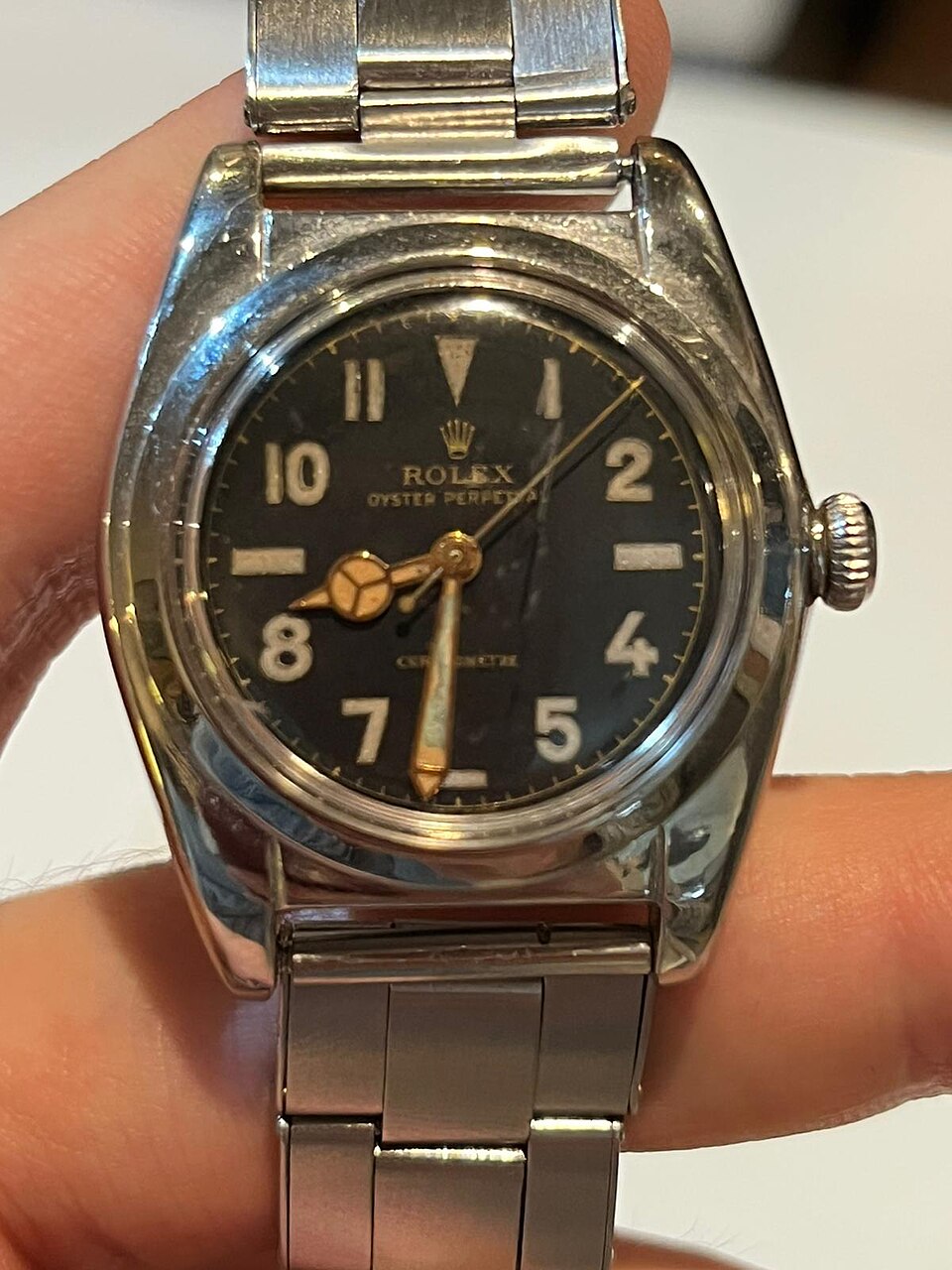
Rolex Early Perpetual

Widths differ across this line. Enter or pick your exact reference to get its width.

Rolex Early Perpetual: Rolex Bubbleback ref. 2940, 1940s, per the file description (an early Oyster Perpetual of this era, not ref. 3065 or 3072)
Rolex Bubbleback ref. 2940, 1940s, per the file description (an early Oyster Perpetual of this era, not ref. 3065 or 3072). Photo: EMore98, CC BY-SA 4.0, via Wikimedia Commons · Add your photo

16 or 18 mm

Verification: Listed in our database

Attachment: spring bars

29 to 30 mm cases · 1935 to 1936

Pick your reference

Filter references by lug width

Indicative information. Check your watch before buying a strap: wristreet.com is not responsible for an incorrect size.

Watch line2 references
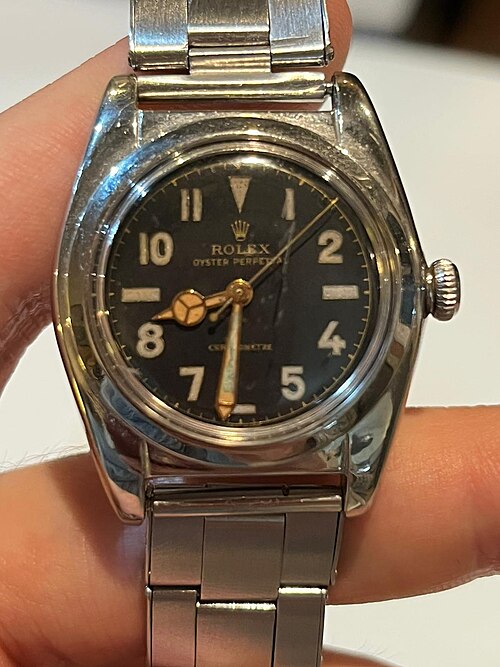
Rolex Early Perpetual: Rolex Bubbleback ref. 2940, 1940s, per the file description (an early Oyster Perpetual of this era, not ref. 3065 or 3072)
Rolex Bubbleback ref. 2940, 1940s, per the file description (an early Oyster Perpetual of this era, not ref. 3065 or 3072). Photo: EMore98, CC BY-SA 4.0, via Wikimedia Commons

Own a Rolex Early Perpetual? Add your photo. Share a photo

The story · Since 1926

The story of the Rolex Early Perpetual

In 1931 Rolex patented a rotor that wound the watch from the movement of the wrist, and so the owner no longer had to unscrew the Oyster crown. The bulky winding module pushed the caseback out into a dome, and collectors later called these first Oyster Perpetuals Bubblebacks.

1931

Year Rolex patented the Perpetual rotor

Read the full storyHide the story
1931Year Rolex patented the Perpetual rotor
172Distinct Bubblebacks documented in Colin A. White's Vintage Rolex Field Manual
Over 22 yearsBubbleback production, early 1930s to mid-1950s
CHF 27,500CHF 27,500: Pink California dial ref. 3065, Christie's, 2014

Chapters

  1. 1926 to 1931

    A waterproof case needing winding

    Rolex launched the Oyster in 1926, a waterproof and dustproof case with a screw-down crown, caseback and bezel. Robb Report recounts that owners forgot to screw the crown back down and blamed dealers for faulty watches. A watch that wound itself would leave the crown alone.

  2. 1931 to 1933

    The Perpetual rotor

    In 1931 Rolex patented a self-winding system with a free rotor called Perpetual. Robb Report says the rotor, developed by movement supplier Aegler, turned through 360 degrees and was fitted on top of a conventional hand-wound movement, so watchmakers could still service it easily.

  3. 1933 to the late 1930s

    Oyster Perpetual on the dial

    The first Bubbleback, ref. 1858 with calibre 520, reached the shops in 1933 in a three-piece 32 mm case. Sotheby's notes that many Bubblebacks were the first watches to carry the words Oyster Perpetual on the dial. Rolex then moved to a two-piece case with refs. 3131 and 3132.

  4. Late 1930s to 1940s

    Hooded lugs and wartime variety

    Ref. 3065 closed the gap between the lugs with a hood over the bracelet attachment; Christie's calls it among the most sought-after Bubbleback variants. Cases came in steel, gold and two-tone, with countless dials, and Phillips writes that for many years the Bubbleback was Rolex's best selling model. Ref. 3372, with a threaded machine bezel, arrived in 1940.

  5. 1945 to 1953

    Larger cases take over

    After the 34 mm Air series and the 36 mm Big Bubbleback and Datejust of 1945, Rolex moved away from the 32 mm Bubbleback. By the time the 36 mm Explorer arrived in 1953, Robb Report says, the Bubbleback was a relic. Phillips puts the whole production at over 22 years, to the mid-1950s.

  6. 1980s to today

    Collector darling, then overlooked

    American collectors chased Bubblebacks in the 1980s, when prices outran Daytonas and Submariners, and many were modified or had dials refinished. Larger steel sports watches then took the spotlight; Sotheby's notes that as small watches return, the 30 to 34 mm Bubbleback is finding new buyers.

Worn by

Louis Mountbatten, 1st Earl Mountbatten of BurmaService1943

His wife Edwina gave him a steel Oyster Perpetual Bubbleback ref. 2940 for their 21st wedding anniversary; the caseback reads Dickie from Edwina, 18th July 1943, and the clasp is inscribed Mountbatten of Burma. Christie's sold it in March 2002 as formerly his property.

Moments

2014. At Christie's on 10 November 2014 a steel and pink gold ref. 3065 with hooded lugs and a pink California dial, circa 1940, made CHF 27,500, above its CHF 10,000 to 20,000 estimate.

2012. A 1943 pink gold ref. 3065 with pink dial signed by retailer Bucherer sold at Christie's for CHF 23,750 against CHF 12,000 to 18,000.

2002. Christie's sold Lord Mountbatten's ref. 2940, a 1943 anniversary gift from his wife, for GBP 11,750 against an estimate of GBP 10,000 to 15,000 (sale closed 20 March 2002).

Phillips Hong Kong sold a rare steel and 14k gold ref. 3065 from the 1940s on a matching C&I bracelet for HK$69,850, above its HK$40,000 to 63,000 estimate; Phillips says most 3065s are full gold or full steel.
Generations and strap changes

  1. 1940
    Ref. 3372

    The Bubbleback with a threaded machine bezel, unusual looking at the time.

    Phillips catalogues it at 32 mm on a Rolex Oyster bracelet.

  2. 1933
    Ref. 1858

    The first Bubbleback: calibre 520 in a three-piece Oyster case.

    Three-piece case of 32 mm.

  3. 1931
    Perpetual rotor patent

    Rolex invented and patented the world's first self-winding mechanism with a Perpetual rotor.

2 Rolex Early Perpetual references

Rolex Early Perpetual references in our database. Each card says where its width comes from: listed by the maker (linked to the maker's page in the details), two independent sources agree, or listed in our database and not yet verified by us.

  • 3065 Early

    Early Perpetual Rotor

    Lug width: 18 mm

    Source: Listed Attachment: Spring bars

    Case size: 29 mmYear: 1935Cream dialCase material: Steel

    Attachment
    classic lugs
    Movement
    Early Automatic (Rotor)
    Caseback
    Screw-down steel
    Production
    1935-1938
    Status
    Listed in our database, not yet verified
  • 3072 Early

    Early Perpetual Rotor

    Lug width: 16 mm

    Source: Listed Attachment: Spring bars

    Case size: 30 mmYear: 1936Silver dialCase material: Steel

    Attachment
    classic lugs
    Movement
    Early Automatic (Rotor)
    Caseback
    Screw-down steel
    Production
    1936-1940
    Status
    Listed in our database, not yet verified

Verified: the width is listed by the maker or confirmed by two independent sources. The other widths are listed in our database.

FAQ

What lug width does the Rolex Early Perpetual use?

Rolex Early Perpetual references use 16 mm or 18 mm depending on the reference and case size, so check yours in the list below. The most common is 18 mm (1 of 2 references with a known width). These widths are listed in our database; the maker check is in progress.

Do all Rolex Early Perpetual references take the same strap?

No. 2 different lug widths appear across the line, often by case size or generation. Check the reference engraved on the case back or between the lugs.

How big is a Bubbleback ref. 3065?

Auction houses that catalogued ref. 3065 measured the case at 32 to 33 mm across (Christie's 33 and 32.5 mm, Bonhams 33 mm, Phillips 32 mm). Sotheby's says most Bubblebacks are 30 to 34 mm and that hooded-lug models looked large in their day.

What do hooded lugs mean for a strap or bracelet?

Christie's describes the inlay between the lugs as what gives such models the hooded name. Auction examples of the 3065 came on Rolex expandable riveted bracelets and leather straps.

Why does a Bubbleback sit high on the wrist?

The rotor and winding assembly were added on top of a hand-wound movement, so the caseback had to bulge outward. Robb Report notes that the domed caseback sat the watch higher off the wrist.

Other Rolex collections

Help

What is lug width?

The gap between the two lugs that hold the strap, in millimetres. A new strap must match it exactly: 20 mm lugs take a 20 mm strap.

Measure it in 30 seconds

  1. Take the strap off, or look at the back of it: many straps print their width.
  2. Measure the inside gap between the lugs with a caliper or a millimetre ruler.
  3. Round to the nearest whole millimetre. Most watches use 18, 20 or 22 mm.

Strap, quick release or system?

Most watches use spring bars, so any strap of the right width fits. Many smartwatches use their own band system instead, such as Apple Watch bands or Garmin QuickFit.